


Category : Reports
Results for Children
Posted in Reports
The Good Life: Eighth Century to Fourth Century BCE
In very broad strokes one may think of the quality of life of an individual or community as a function of the actual conditions of that life and what an individual or community makes of those conditions. What a person or community makes of those conditions is in turn a function of how the conditions are perceived, what is thought and felt about those conditions, what is done and finally, what consequences follow from what is done. People’s perceptions, thoughts, feelings and actions, then, have an impact on their own and others’ living conditions.
Posted in Reports
Fifty Years after the Social Indicators Movement: Has the Promise been Fulfilled?

This paper reviews the origins, promise, and subsequent development of social indicators /quality-of-life/well-being conceptualizations and research since the 1960s. It then assesses the state of this field in the 2010s and identifies four key developments – the development of professional organizations that nurture its conceptual and empirical development; the widespread political, popular, and theoretical appeal of the quality-of-life (QOL) concept; a new era of the construction of composite or summary social indicators; and a recognition of the key role of the QOL concept in connecting social indicators to the study of subjective well-being – that have evolved over the past five decades and that are very much with us today. The final section of the paper poses the question of where the field should focus its energies. Beyond carrying on the existing research program, it argues that the field needs to recognize the substantial changes in the social and economic organization of contemporary societies as compared to the mid-1960s launch period for the Social Indicators Movement and develop new research foci for the years to come.
Posted in Reports
Global Change and Indicators of Social Development

Knowledge-based intervention has been a hallmark of community practice since the turn of the last century. Indeed, the social survey and charity organization movements of the 1900s were a direct outgrowth of efforts on the part of community practitioners to systematically: 1) identify the nature, extent and severity of new and emerging social needs in their communities; 2) organize people and institutions to respond more effectively to those needs; and 3) establish baseline measures against which intervention successes and failures could be assessed (Bartlett, 1928; Richmond, 1917; Zimbalist, 1977). Even the renaming of one of the profession’s leading journals of the day, Charities and the Commons, to The Survey illustrates the importance that practitioners assigned to the role of scientific inquiry for advancing practice. Mary Richmond’s Social Diagnosis (1917) offered further reinforcement of the important relationship that practitioners recognized to exist between knowledge-based intervention and the realization of more effective outcomes. Today, of course, community practitioners all over the world seek to incorporate rigorous approaches to needs assessment, planning, program development and evaluation in their work with communities (Community Indicators Consortium, 2010; Daskon & Binns, 2010; Environment Canada, 2010; Hung & Fung, 2010; Ravensbergen & VanderPlaat, 2010; Wehbi, et al., 2010).
Posted in Reports
World Happiness Report 2013

The world is now in the midst of a major policy debate about the objectives of public policy. What should be the world’s Sustainable Development Goals for the period 2015-2030? The World Happiness Report 2013 is offered as a contribution to that crucial debate.
In July 2011 the UN General Assembly passed a historic resolution. 1 It invited member countries to measure the happiness of their people and to use this to help guide their public policies. This was followed in April 2012 by the first UN high-level meeting on happiness and well-being, chaired by the Prime Minister of Bhutan. At the same time the first World Happiness Report was published, 2 followed some months later by the OECD Guidelines setting an international standard for the measurement of well-being. 3 The present Report is sponsored by the Sustainable Development Solutions Network.
Posted in Reports
Indigenous Peoples: Still among the poorest of the poor
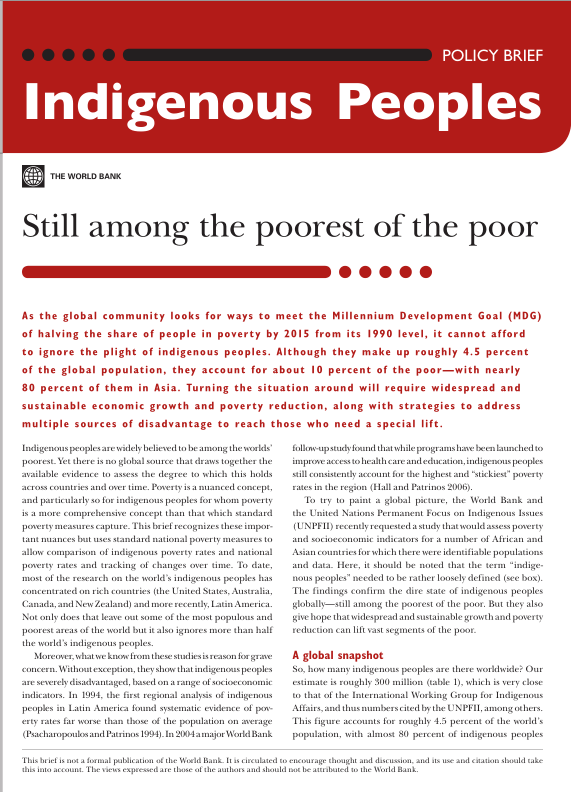
As the global community looks for ways to meet the Millennium Development Goal (MDG) of halving the share of people in poverty by 2015 from its 1990 level, it cannot afford to ignore the plight of indigenous peoples. Although they make up roughly 4.5 percent of the global population, they account for about 10 percent of the poor—with nearly 80 percent of them in Asia. Turning the situation around will require widespread and sustainable economic growth and poverty reduction, along with strategies to address multiple sources of disadvantage to reach those who need a special lift.
Posted in Reports
World Development Report 2013: Jobs

Today, jobs are a critical concern across the globe—for policy makers, the business community, and the billions of men and women striving to provide for their families. As the world struggles to emerge from the global crisis, some 200 million people—including 75 million under the age of 25—are unemployed. Many millions more, most of them women, find themselves shut out of the labor force altogether. Looking forward, over the next 15 years an additional 600 million new jobs will be needed to absorb burgeoning working-age populations, mainly in Asia and Sub-Saharan Africa.
Meanwhile, almost half of all workers in developing countries are engaged in small-scale farming or self-employment, jobs that typically do not come with a steady paycheck and benefits. The problem for most poor people in these countries is not the lack of a job or too few hours of work; many hold more than one job and work long hours. Yet, too often, they are not earning enough to secure a better future for themselves and their children, and at times they are working in unsafe conditions and without the protection of their basic rights.
Jobs are instrumental to achieving economic and social development. Beyond their critical importance for individual well-being, they lie at the heart of many broader societal objectives, such as poverty reduction, economy-wide productivity growth, and social cohesion. The development payoffs from jobs include acquiring skills, empowering women, and stabilizing post-conflict societies. Jobs that contribute to these broader goals are valuable not only for those who hold them but for society as a whole: they are good jobs for development.
The World Development Report 2013 takes the centrality of jobs in the development process as its starting point and challenges and reframes how we think about work. Adopting a cross-sectoral and multidisciplinary approach, the Report looks at why some jobs do more for development than others. The Report finds that the jobs with the greatest development payoffs are those that make cities function better, connect the economy to global markets, protect the environment, foster trust and civic engagement, or reduce poverty. Critically, these jobs are not only found in the formal sector; depending on the country context, informal jobs can also be transformational.
Posted in Reports
Subjective Wellbeing, Psychological needs, Meaning in life, Religious practice and Income in the Population of Algeria

The present study investigated the relationship between Subjective Wellbeing (Satisfaction with life (SWL), Personal Wellbeing Index (PWI), Positive Affect (PA) and Negative Affect (NA)), Psychological needs (Autonomy, Competence and Relatedness), Meaning in Life, and Religious Practice. It examined the distributions of these constructs in a large sample of 3,173 subjects (1,638 males and 1,535 females) who participated in the 4 th Algerian Wellbeing Survey. It aimed also to weigh up to what extent they were affected by household income. Finally, it estimated the mediating effect of demographic variables (gender, age, education and location) in the contribution of the studied constructs in each other.
The results indicated that these constructs were significantly inter-correlated and almost similarly distributed in this population. They also showed that they were all negatively affected by low incomes and proved that generally and beyond demographic factors, SWB measures predict better needs satisfaction, meaning in life and religiosity than the opposite direction. The results were discussed on the light of previous international wellbeing research.
Posted in Reports
The Quality of Life of Muslim Populations: The Case of Algeria
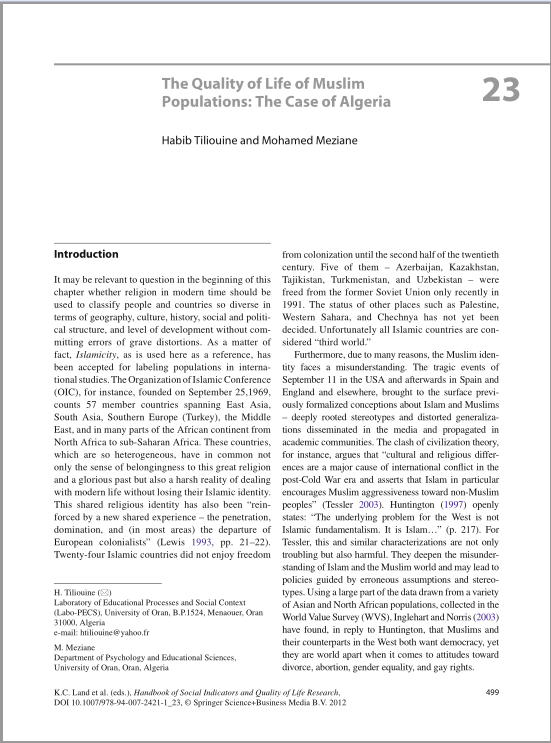
It may be relevant to question in the beginning of this chapter whether religion in modern time should be used to classify people and countries so diverse in terms of geography, culture, history, social and political structure, and level of development without committing errors of grave distortions. As a matter of fact, Islamicity , as is used here as a reference, has been accepted for labeling populations in international studies. The Organization of Islamic Conference (OIC), for instance, founded on September 25,1969, counts 57 member countries spanning East Asia, South Asia, Southern Europe (Turkey), the Middle East, and in many parts of the African continent from North Africa to sub-Saharan Africa. These countries, which are so heterogeneous, have in common not only the sense of belongingness to this great religion and a glorious past but also a harsh reality of dealing with modern life without losing their Islamic identity. This shared religious identity has also been “reinforced by a new shared experience – the penetration, domination, and (in most areas) the departure of European colonialists” (Lewis 1993 , pp. 21–22). Twenty-four Islamic countries did not enjoy freedom from colonization until the second half of the twentieth century. Five of them – Azerbaijan, Kazakhstan, Tajikistan, Turkmenistan, and Uzbekistan – were freed from the former Soviet Union only recently in 1991. The status of other places such as Palestine, Western Sahara, and Chechnya has not yet been decided. Unfortunately all Islamic countries are considered “third world.”
Posted in Reports
State of the World 2013: Is Sustainability Still Possible?

We live today in an age of sustainababble, a cacophonous profusion of uses of the word sustainable to mean anything from environmentally better to cool. The original adjective—meaning capable of being maintained in existence without interruption or diminution—goes back to the ancient Romans. Its use in the environmental field exploded with the 1987 release of Our Common Future, the report of the World Commission on Environment and Development. Sustainable development, Norwegian Prime Minister Gro Harlem Brundtland and the other commissioners declared, “meets the needs of the present without compromising the ability of future generations to meet their own needs.”
Posted in Reports


