
The Quality-of-College-Life Survey is a standardized survey that have been administered at many colleges and universities in the U.S. and other countries to assess the level of quality of college life.
The Theoretical Model Underlying the Quality-of-College-Life Survey
Description of the Quality-of-College-Life Survey
Conducting the Quality-of-College-Life Survey
The Quality-of-College-Life Survey Report
Project Fee
The Theoretical Model Underlying the Quality-of-College-Life Survey
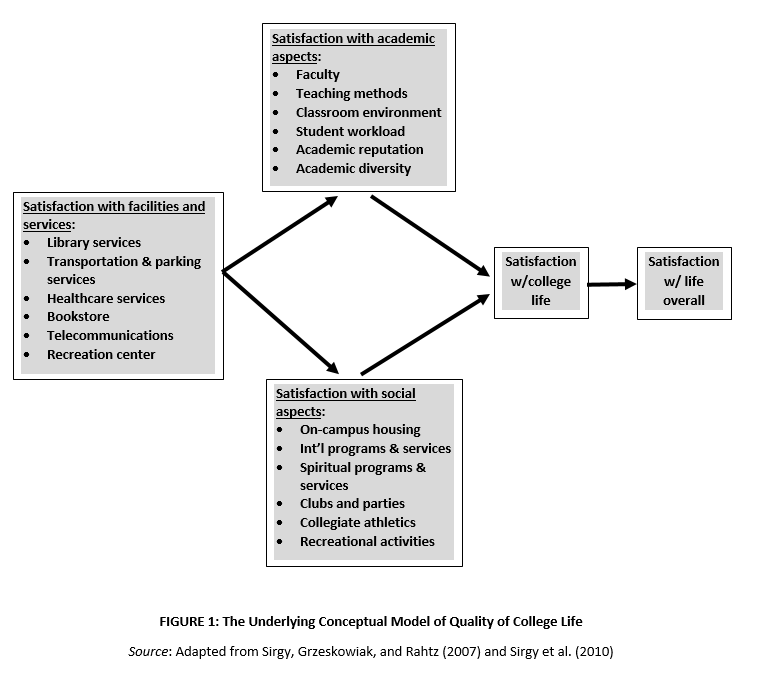
The conceptual model underlying the Quality-of-College-Life Survey is shown in Figure 1 below (Sirgy, Grzeskowiak, & Rahtz, 2007; Sirgy et al., 2010). As shown in the figure, satisfaction with life overall (survey item: “How satisfied are you with life in general?” Responses captured on a 5-point satisfaction rating scale) for college students is heavily influenced by satisfaction with college life (survey item: “In general, how satisfied are you with the overall quality of student life at (name of college or university]?”).
Satisfaction with college life is construed to be determined by two major factors, namely satisfaction with academic aspects (i.e., survey items capturing satisfaction with faculty, teaching methods, classroom environment, student workload, academic reputation, and academic diversity) and satisfaction with social aspects survey items capturing satisfaction with on-campus housing, international programs and services, spiritual programs and services, clubs and parties, collegiate athletics, and recreational activities).
In turn, both satisfaction with academic aspects and satisfaction with social aspects are influenced by satisfaction with facilities and services (survey items capturing satisfaction with library services, transportation and parking, healthcare services, bookstore, telecommunications, and recreation center).
References
Sirgy, M. J., Grzeskowiak, S., & Rahtz, D. (2007). Quality of college life (QCL) of students: Developing and validating a measure of well-being. Social Indicators Research, 80, 343–360.
Sirgy, M. J., Lee, D. J., Grzeskowiak, S., Yu, G. B., Webb, D., El Hasan, K., et al. (2010). Quality of college life (QCL) of students: Further validation of a measure of well-being. Social Indicators Research, 99(3), 375–390.
Bibliography
Arslan, S., & Akkas, O. A. (2014). Quality of college life (QCL) of students in Turkey: Students’ life satisfaction and identification. Social Indicators Research, 115, 869-884.
Babao, G. A. M., Kolesnikov, P., Pajarito, K. K. V., Jael, S. A., Mergal, B. B., Bingcang, A. G. F., … & Rey, K. A. M. (2022). Personality Type and Perceived Quality of Life of Selected College Students. 8ISC Proceedings: Social Sciences, 10-26.
Bao, D. Q., Phong, N. D., & Tho, N. D. (2023). Co-creation in higher education and quality of college life: The roles of students’ co-creation effort, interactions, and mindfulness. The International Journal of Management Education, 21(3), 100862. https://doi.org/10.1016/j.ijme.2023.100862.
Bini, M., & Masserini, L. (2016). Students’ satisfaction and teaching efficiency of university offer. Social Indicators Research, 129, 847-862. https://doi.org/10.1007/s11205-015-1141-0
Botha, F., Snowball, J., de Klerk, V., & Radloff, S. (2015). Determinants of student satisfaction with campus residence life at a South African university. A New Research Agenda for Improvements in Quality of Life, 17-35. https://doi.org/10.1007/978-3-319-15904-1_2
Cheng, S., & Sin, K. F. (2018). Conceptions of learning and quality of university life among deaf, hard of hearing, and hearing university students. International Journal of Inclusive Education, 22(12), 1333-1344.
Cheng, S., & Sin, K. F. (2022). University self-efficacy and quality of university life among students with and without hearing impairment and hearing students. International Journal of Disability, Development and Education, 69(5), 1537-1549.
Dalaman, O., Özkurt, R., & Pepe, K. (2020). Investigation Of University Students’ Overall Quality Of College Life And Their Satisfaction With This Life Terms Of Their Genders And Departments. Turkish Journal of Sport and Exercise, 22(1), 154-160.
El Hassan, K. (2011). Quality of college life (QCL): Validation of a measure of student well-being in the Middle East. The International Journal of Educational and Psychological Assessment, 8(1), 12-22.
Eris, H., & Anil, D. (2016). An Examination of the levels of university student’s quality of life in terms of some variables. Hacettepe Universitesi Egitim Fakultesi Dergisi-Hacettepe University Journal of Education, 31(3).
Gabbianelli, L., & Pencarelli, T. (2023). On-campus accommodation service quality: the mediating role of students’ satisfaction on word of mouth. The TQM Journal, 35(5), 1224-1255. https://doi.org/10.1108/TQM-03-2022-0092
Gbadegesin, J. T., Komolafe, M. O., Gbadegesin, T. F., & Omotoso, K. O. (2021). Off-campus student housing satisfaction indicators and the drivers: From student perspectives to policy re-awakening in governance. Journal of Human Behavior in the Social Environment, 31(7), 889-915.
Haron, H., Osman, B. M., Maidinsah, H., Sari, M. M. M., & Zaki, N. Q. M. (2015, February). Determinants of quality of life (qol) and quality of university life (qul) in Malaysian public university students. In AIP Conference Proceedings (Vol. 1643, No. 1, pp. 505-511). American Institute of Physics. https://doi.org/10.1063/1.4907486
Hu, X., Cheng, S., & Hu, H. (2022). Religiousness predicts quality of university life among university students with different religion types. Journal of Beliefs & Values, 43(3), 285-300.
Khatri, P., & Duggal, H. K. (2022). Well‐being of higher education consumers: A review and research agenda. International Journal of Consumer Studies, 46(5), 1564-1593. https://doi.org/10.1111/ijcs.12783
Kumar, K., & Chaturvedi, R. (2018). An empirical study of social support, stress and life satisfaction among engineering graduates: mediating role of perceived work/study life balance. International Journal of Happiness and Development, 4(1), 25-39.
Mahdi, R. (2016). Evaluation of the quality of college life of native and non-native students in engineering higher education. Majallah-i Amuzih-i Muhandisi-i Iran, 18(71), 1.
Muhammad, S., Sapri, M., & Sipan, I. (2014). Academic buildings and their influence on students’ wellbeing in higher education institutions. Social Indicators Research, 115, 1159-1178. https://doi.org/10.1007/s11205-013-0262-6
Nguyen, T. D., Shultz, C. J., & Westbrook, M. D. (2012). Psychological hardiness in learning and quality of college life of business students: evidence from Vietnam. Journal of Happiness Studies, 13(6), 1091-1103. https://doi.org/10.1007/s10902-011-9308-0
Nowell, C. (2017). The influence of motivational orientation on the satisfaction of university students. Teaching in Higher Education, 22(7), 855-866.
Pedro, E., Leitão, J., & Alves, H. (2016). Does the quality of academic life matter for students’ performance, loyalty and university recommendation?. Applied Research in Quality of Life, 11, 293-316. https://doi.org/10.1007/s11482-014-9367-6
Pedro, E. D. M., Alves, H., & Leitão, J. (2018). Does the quality of academic life mediate the satisfaction, loyalty and recommendation of HEI students?. International Journal of Educational Management, 32(5), 881-900. https://doi.org/10.1108/IJEM-04-2017-0086
Pedro, E., Leitão, J., & Alves, H. (2020). Unveiling the relationship between quality of academic life and regional development. European Journal of Higher Education, 10(1), 48-71.
Petrovič, F., Murgaš, F., Tirpáková, A., Hubálovská, M., Molnár, G., Králik, R., … & Balogh, Z. (2025). Measuring the quality of life university students and its predictors as a basis for its applied research. Cross-country evidence. Sustainable Futures, 10, 101214.
Posadzki, P., Musonda, P., Debska, G., & Polczyk, R. (2009). Psychosocial conditions of quality of life among undergraduate students: a cross sectional survey. Applied Research in Quality of Life, 4, 239-258. https://doi.org/10.1007/s11482-009-9064-z
Sanko, A. M. The Quality Of Life As Seen By Russian Students. European Proceedings of Social and Behavioural Sciences. https://doi.org/10.15405/epsbs.2020.03.4
Tho, N. D., Trang, N. T., & Gregory, S. (2020). Positivity and quality of college life of business students: The mediating role of learning approaches. Studies in Educational Evaluation, 66, 100908. https://doi.org/10.1016/j.stueduc.2020.100908
Soh, J. E., & Kim, T. S. (2018). Comparison of Students’ Satisfaction among Related Disciplines of Undergraduate MIS Majors. Journal of Information Technology Applications and Management, 25(2), 91-108. https://doi.org/10.21219/JITAM.2018.25.2.091
Tonon, G. H. (2021). Student’s quality of life at the university: A qualitative study. Applied Research in Quality of Life, 16(4), 1517-1535. https://doi.org/10.1007/s11482-020-09827-0
Ulyani Mohd Najib, N., Aini Yusof, N., & Zainul Abidin, N. (2011). Student residential satisfaction in research universities. Journal of Facilities management, 9(3), 200-212. https://doi.org/10.1108/14725961111148108
Xiao, J. J., Tang, C., & Shim, S. (2009). Acting for happiness: Financial behavior and life satisfaction of college students. Social indicators research, 92, 53-68. https://doi.org/10.1007/s11205-008-9288-6
Yılmaz, D. V. (2019). UnilQual: University Life Quality Scale. OPUS International Journal of Society Researches, 10(17), 923-948. https://doi.org/10.26466/opus.516649
Yu, G., & Lee, D. J. (2008). A model of quality of college life (QCL) of students in Korea. Social Indicators Research, 87, 269-285.
Yu, G. B., & Kim, J. H. (2008). Testing the mediating effect of the quality of college life in the student satisfaction and student loyalty relationship. Applied Research in Quality of Life, 3, 1-21.
Description of the Quality-of-College-Life Survey
The survey is divided into five major sections: (1) satisfaction with academic aspects, (2) satisfaction with social aspects, (3) satisfaction with facilities and services, (4) overall ratings of student quality of life, and (5) demographics (see survey questionnaire).
Section 1 (satisfaction with academic aspects of college life). In this section, survey participants rate their satisfaction with various aspects of academic life such as faculty, teaching methods, classroom environment, student workload, academic reputation, and academic diversity. See exact items of this construct in the actual online survey questionnaire located on the Example Survey page.
Section 2 (satisfaction with social aspects of college life). In this section, survey participants rate their satisfaction with various aspects of social life such as on-campus housing, international programs and services, spiritual programs and services, clubs and parties, collegiate athletics, and recreational activities. See exact items of this construct in the actual online survey questionnaire located on the Example Survey page.
Section 3 (satisfaction with facilities and services). In this section, survey participants rate their satisfaction with various facilities and services such as library services, transportation and parking services, healthcare services, bookstore, telecommunications, and recreation center. See exact items of this construct in the actual online survey questionnaire located on the Example Survey page.
Section 4 (overall ratings of student quality of life). In this section, survey participants rate their satisfaction with their life in general and their satisfaction with college life overall. See exact items of this construct in the actual online survey questionnaire located on the Example Survey page.
Section 5 contains demographic items such as age, gender, marital status, full-time vs. part-time employment, class level, etc. See examples of demographic items in the actual online survey questionnaire located on the Example Survey page.
Conducting the Quality-of-College-Life Survey
The Management Institute for Quality-of-Life Studies (MIQOLS) provides college administration of any college or university worldwide with assistance in conducting the Quality-of-College-Life Survey (online) at their own campus. The Quality-of-College-Life Survey is first adapted to the exact specification of the college/university in question. The adapted version of the Quality-of-College-Life Survey is then posted on MIQOLS website for data collection. The staff at the applicant college/university publicizes a call to their students to complete the online survey anonymously and confidentially. A link is provided with the call to complete the survey with a specific deadline.
After the deadline, the survey site is closed, data analyzed, and a report is issued to the applicant college/university. To see an example of a typical report, see The Quality-of-College-Life Survey Report below.
The Quality-of-College-Life Survey Report

The report is structured as follows:
-
- Cover page: A title page with applicant contact information and MIQOLS contact information
- Executive Summary: The entire content of the report is summarized here.
- Theory and Model: The theoretical model underlying the Quality-of-College-Life Survey is described here and the theoretical constructs are clearly defined. The research supporting the Quality-of-College-Life model is also discussed in this section.
- Description of the Quality-of-College-Life Survey: This section contains a description of the constructs with corresponding survey items.
- Sampling and Data Collection: This part of the report describes the call issued to students to participate in the Quality-of-College-Life Survey, the deadline imposed, any incentives used to encourage student participation, the survey link, the number of students who actually participated in the survey, the total number of students contacted, and the response rate. The response rate of the college/university in question is compared to past response rates of other colleges and universities.
- Survey Results: This section of the report provides descriptive statistics related to each survey item with figures (e.g., bar charts) against the norm. The norm is calculated based on the average of all past surveys that have been administered through MIQOLS.
- Discussion and Recommendations: The survey results are then summarized and interpreted in this section. As such, specific strengths and weaknesses are identified. The college administration is then encouraged to bolster their strengths and correct weaknesses.
- References: Exact references of corresponding text citations are fleshed out in this section.
- Appendices: Extra detailed information related to any aspect of the report is placed in this section.
Project Fee
$500 for an Excel data file containing the survey data (with a coding sheet) plus statistical norms for every survey item. If you would like a full report with charts and recommendations, you can contact our office (office@miqols.org) to discuss in detail your requirements and the corresponding payment.
To request MIQOLS to conduct a Quality-of-College-Life Survey, please send an e-mail message to the executive director of MIQOLS, Joe Sirgy, at office@miqols.org indicating interest. You can also contact MIQOLS by letter (address: 6020 Lyons Road, Dublin, Virginia 24084, USA) or by phone (540-674-5022; leave voicemail message). A staff member will contact you by e-mail to set up a telephone (or Skype or ZOOM) meeting. The staff member will answer whatever questions you may have and discuss the logistics of the entire project, the cost, survey specifications, time line, delivery of the survey report and other details