Consolidated Books Website

Category : Reports

Buen Vivir: Today’s tomorrow

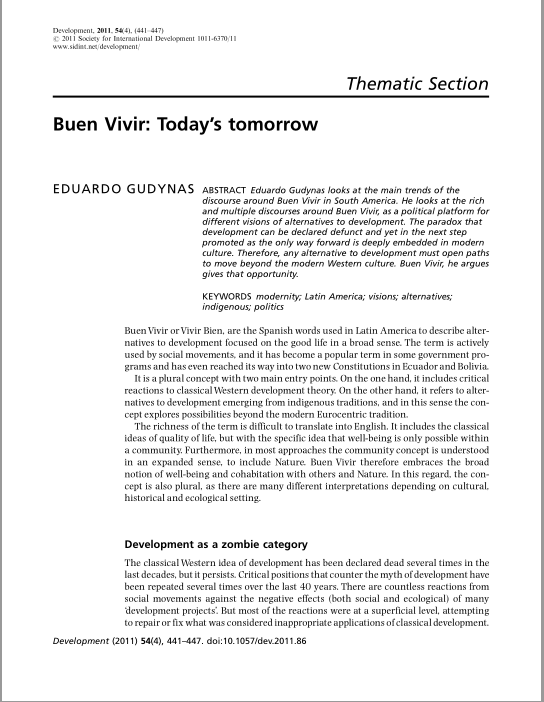
Buen Vivir or Vivir Bien, are the Spanish words used in Latin America to describe alternatives to development focused on the good life in a broad sense. The term is actively used by social movements, and it has become a popular term in some government programs and has even reached its way into two new Constitutions in Ecuador and Bolivia.

It is a plural concept with two main entry points. On the one hand, it includes critical reactions to classical Western development theory. On the other hand, it refers to alternatives to development emerging from indigenous traditions, and in this sense the concept explores possibilities beyond the modern Eurocentric tradition.

The richness of the term is difficult to translate into English. It includes the classical ideas of quality of life, but with the specific idea that well-being is only possible within a community. Furthermore, in most approaches the community concept is understood in an expanded sense, to include Nature. Buen Vivir therefore embraces the broad notion of well-being and cohabitation with others and Nature. In this regard, the concept is also plural, as there are many different interpretations depending on cultural, historical and ecological setting.

Posted in Reports

Global Peace Index

This is the ninth edition of the Global Peace Index (GPI), which ranks the nations of the world according to their level of peacefulness. The index is composed of 23 qualitative and quantitative indicators from highly respected sources and ranks 162 independent states, covering 99.6 per cent of the world’s population. The index gauges global peace using three broad themes: the level of safety and security in society, the extent of domestic and international conflict and the degree of militarisation.
Posted in Reports

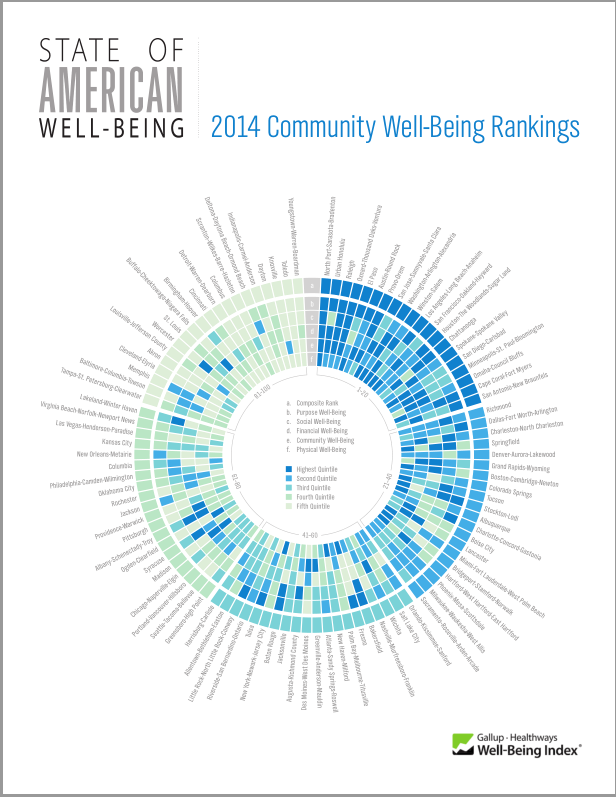
State of American Well-Being: 2014 Community Well-Being Rankings

This report, the second in a series, shows the well-being of our nation’s 100 largest communities, as measured by the Gallup-Healthways Well-Being Index®, which captures how people feel about and experience their daily lives. Well-being is correlated with healthcare utilization and cost as well as productivity measures like absenteeism, presenteeism and job performance — all critical to organizational and economic competitiveness.
Posted in Reports

“Failed” and “Failing” States: Is Quality of Life Possible?

Nation-states (hereafter “nations,” “countries,” or “states”) are internationally autonomous political entities that are bound together by a system of laws, a defi ned (but not necessarily contiguous) geographic space, and a commitment to the pursuit of the collective well-being of their inhabitants. 1 Though quite diverse in geographic size, population characteristics, type of polity, and economic system, nations share a variety of features common with one another (Britannica Online 2011a; Moran et al. 2006; Weingast and Wittman 2006). Rank ordered more or less in terms of their importance, they include (1) recognition of their political sovereignty by other nations; (2) a coherent set of principles that guide their interactions with other sovereign states; (3) secure physical borders; (4) the administration of justice within a system of laws to which, optimally, the governed have assented (e.g., via a written constitution and an independent judiciary); (5) the provision of a range of “public goods” designed to meet the collective needs of their populations (e.g., the creation of monetary and banking systems, road-building and other transportation networks, the development of communications infrastructure, and the provision of at least limited health, education, and related human services) 2 ; (6) special initiatives designed to meet the income security and related needs of their most vulnerable inhabitants (e.g., children, the elderly, persons with chronic illnesses or disabilities, unemployed persons, etc.); and (7) a commitment to promotion of the general well-being of the society-as-a-whole (Kim et al. 2010 ; Plato 2000 ; Sachs 2005 ; Schyns and Koop 2010) . In democratic societies, states also carry responsibility for the conduct of fair and open elections and for the promotion of a broad range of civil liberties and political freedoms – all of which are considered necessary elements in the functioning of pluralistic, participatory, societies (Freedom House 2010 ; Human Rights Watch 2010; Tsai 2006) .
Posted in Reports

Economies in Transition: Revisiting Challenges to Quality of Life

“Economies in Transition” (hereafter referred to as “EITs”) consist of 31 geographically dispersed nations (International Monetary Fund 2010) with a combined population of 1,916 million—approximately 27.8% of the world’s total in 2010 (UNPOP 2010) . EITs are located in East and Southeast Asia (N = 4), Central and Eastern Europe (N = 10), and Central Asia (N = 11). They also include China, Turkey, the Russian Federation, and the three Baltic States of Estonia, Latvia, and Lithuania. Other countries are regarded as EITs, but the challenges associated with their development have tended to be longer in duration (e.g., Brazil, India, Indonesia, and Mexico, among others). The majority of countries classifi ed as EITs in this study are relatively young—most having achieved their independence only since the collapse of the former Soviet Union in December 1991. The social, political, and economic transitions for some of the study’s EITs began earlier than 1991, but owing to their long histories, large geographic territories, and current political complexities, their transition process has moved more slowly, i.e., the Russian Federation (1917), Turkey (1923), and China (1949).
Posted in Reports

The World Social Situation: Development Challenges at the Outset of a New Century

World social development has arrived at a critical turning point. Economically advanced nations have made significant progress toward meeting the basic needs of their populations; however, the majority of developing countries have not. Problems of rapid population growth, failing economies, famine, environmental devastation, majority-minority group conflicts, increasing militarization, among others, are pushing many developing nations toward the brink of social chaos. This paper focuses on worldwide development trends for the 40-year period 1970–2009. Particular attention is given to the disparities in development that exist between the world’s “rich” and “poor” countries as well as the global forces that sustain these disparities. The paper also discusses more recent positive trends occurring within the world’s “socially least developed countries” (SLDCs), especially those located in Africa and Asia, in reducing poverty and in promoting improved quality of life for increasing numbers of their populations.
Posted in Reports

Development Trends in Islamic Societies: From Collective Wishes to Concerted Actions

Today, approximately one-fourth of the world’s population includes 1,620 million persons who are part of the expanding Islamic Ummah. Muslims are found in large numbers in all regions of the world but are concentrated in Africa, Asia, the Middle East and selected successor states to the former Soviet Union. Despite the obvious wealth of some Islamic nations most Muslims live under conditions of poverty, joblessness, illiteracy, ill health, social and political unrest and, in some regions, religious extremism. Using the extensively pre-tested Weighted Index of Social Progress, this paper reports a 40-year time series analysis of the nature, extent, and pace of social change that is taking place within 53 of the 57 member states of the Organization of Islamic Cooperation (OIC). Data are reported at four levels of analysis. Selected data also are reported for both the OIC-as-a-whole and for the world-as-a-whole. The present analysis offers a sometimes bleak, but generally optimistic, picture of the dramatic differences that characterize development patterns within Islamic countries, subregions, and regions. Particular attention is given to: (a) the legacy of colonialism that persisted for some OIC states until as recently as 1991; (b) the recurrent social unrest that continues to characterize development in many Islamic states, e.g., the ‘‘Arab Spring’’ (Vision of Humanity 2012); (c) the presence or absence of marketable natural and human resources; and, (d) the significant contributions being made to the development of Islamic countries by the United Nations’ Millennium Development Campaign (United Nations 2005) and the OIC’s Ten-Year Programme of Action (OIC 2005). However, the important social gains reported in this paper for some countries and geographic regions remain highly variable, potentially reversible, unless the collective wishes of Islamic nations are translated into concerted actions both within OIC member states and the larger world community of nations.
Posted in Reports

Theory and Validity of Life Satisfaction Scales

National accounts of subjective well-being are being considered and adopted by nations. In order to be useful for policy deliberations, the measures of life satisfaction must be psychometrically sound. The reliability, validity, and sensitivity to change of life satisfaction measures are reviewed. The scales are stable under unchanging conditions, but are sensitive to changes in circumstances in people’s lives. Several types of data indicate that the scales validly reflect the quality of respondents’ lives: (1) Differences between nations in life satisfaction associated with differences in objective conditions, (2) Differences between groups who live in different circumstances, (3) Correlations with nonself-report measures of life satisfaction, (4) Genetic and physiological associations with life satisfaction, (5) Systematic patterns of change in the scales before, during, and after significant life events, and (6) Prediction by life satisfaction scores of future behaviors such as suicide. The life satisfaction scales can be influenced by factors such as question order, current mood, and mode of presentation, but in most cases these can be controlled. Our model of life satisfaction judgments points to the importance of attention, values, standards, and top-down effects. Although the scales are useful in research on individual well-
being, there are policy questions that need more analysis and research, such as which types of subjective well-being measures are most relevant to which types of policies, how standards influence scores, and how best to associate the scores with current policy deliberations.
Posted in Reports

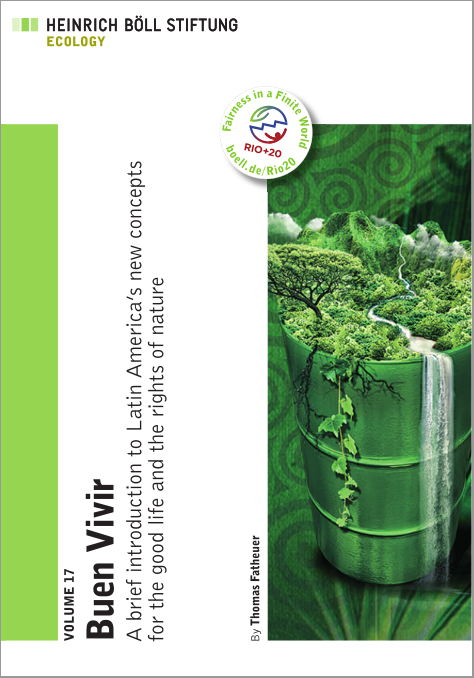
Buen Vivir

A brief introduction to Latin America’s new concepts
for the good life and the rights of nature.
Posted in Reports

China’s life satisfaction, 1990–2010

Despite its unprecedented growth in output per capita in the last two decades, China has essentially followed the life satisfaction trajectory of the central and eastern European transition countries—a U-shaped swing and a nil or declining trend. There is no evidence of an increase in life satisfaction of the magnitude that might have been expected to result from the fourfold improvement in the level of per capita consumption that has occurred. As in the European countries, in China the trend and U-shaped pattern appear to be related to a pronounced rise in unemployment followed by a mild decline, and an accompanying dissolution of the social safety net along with growing income inequality. The burden of worsening life satisfaction in China has fallen chiefly on the lowest socioeconomic groups. An initially highly egalitarian distribution of life satisfaction has been replaced by an increasingly unequal one, with decreasing life satisfaction in persons in the bottom third of the income distribution and increasing life satisfaction in those in the top third.
Posted in Reports