

The Life Satisfaction Survey is a standardized survey that has been administered to many communities in the U.S. and other countries to assess the level of life satisfaction.
The Theoretical Model Underlying the Life Satisfaction Survey
Description of the Life Satisfaction Survey
Conducting the Life Satisfaction Survey
Project Fee
The Theoretical Model Underlying the Survey
The conceptual model underlying the Life Satisfaction Survey is shown in the figure below (Sirgy et al., 1995). The life satisfaction measure is
derived from the congruity life satisfaction (CLS) measure. The CLS scale
involved ten self-report items in which respondents are asked to indicate responses using a 6-point scale varying from “Very Dissatisfied”
– (1) to “Very Satisfied (6). The specific items include:
- Item 1- one’s life accomplishments involving a standard based on
ideal outcomes, - Item 2- the standard based on deserved outcomes,
- Item 3- the standard based on relatives,
- Item 4- the standard based on friends/associates,
- Item 5- the standard based on average persons in similar positions,
- Item 6- the standard based on past experience,
- Item 7- the standard based on self-concept of strengths and
weaknesses - Item 8- the standard based on predicted outcomes,
- Item 9- the standard based on expected outcomes, and
- Item 10- the standard based on minimum tolerable outcomes.
The life satisfaction measure has been administered in a variety of communities to capture the life satisfaction and has been validated in terms of its prediction of constructs such as satisfaction in non-work domains and life satisfaction.
See exact items of the Life Satisfaction measure and other model constructs shown in the figure in the actual online survey questionnaire in the survey.

References
Sirgy, M. J., Cole, D., Kosenko, R., Meadow, H. L., Rahtz, D., Cicic, M., … & Nagpal, N. (1995). A life satisfaction measure: Additional validational data for the congruity life satisfaction measure. Social Indicators Research, 34(2), 237-259.
Bibliography
Burroughs, J. E., & Rindfleisch, A. (2002). Materialism and well-being: A conflicting values perspective. Journal of Consumer research, 29(3), 348-370.
de Vries, J. (2013). Quality of life assessment. In Assessment in behavioral medicine (pp. 353-370). Routledge.
Diener, E., & Fujita, F. (2013). Social comparisons and subjective weil-being. In Health, coping, and well-being (pp. 329-357). Psychology Press.
Howell, R. T., & Howell, C. J. (2008). The relation of economic status to subjective well-being in developing countries: a meta-analysis. Psychological bulletin, 134(4), 536.
Kasser, T. (2003). The high price of materialism. MIT press.
Kimweli, D. M., & Stilwell, W. E. (2002). Community subjective well-being, personality traits and quality of life therapy. Social indicators research, 60(1), 193-225.
Rojas, M. (2006). Life satisfaction and satisfaction in domains of life: Is it a simple relationship?. Journal of happiness studies, 7(4), 467-497.
Ryan, L., & Dziurawiec, S. (2001). Materialism and its relationship to life satisfaction. Social Indicators Research, 55(2), 185-197.
Sirgy, M. J. (1998). Materialism and quality of life. Social indicators research, 43(3), 227-260.
Sirgy, M. J. (2011). Theoretical perspectives guiding QOL indicator projects. Social Indicators Research, 103(1), 1-22.
Description of the Survey
 |
I. LIFE SATISFACTION MEASURES ideal expectations, deserved expectations, accomplishments of relatives, accomplishments of friends and associates, accomplishments of people in similar positions, past accomplishments, strengths and weaknesses, predicted expectations, expected outcomes, minimum tolerable outcomes |
II. SATISFACTION IN OTHER LIFE DOMAINS family, leisure, finances, health, education, social life, neighborhood life, community life, spiritual life, environment, housing, culture, social status |
| III. OVERALL LIFE SATISFACTION life in general |
VI. DEMOGRAPHICS age, gender, marital status, full-time vs. part-time employment |
Targets of the survey are introduced to the survey questionnaire via a cover letter from the client describing the objectives of the survey as aiming to assess their life satisfaction. Participants are assured that their responses would remain confidential and anonymous.
The questionnaire consists of three major sections. The first section involves the congruity life satisfaction (CLS) measure, which asks respondents to evaluate their life’s accomplishments relative to 10 different standards. See exact items of this construct in the actual online survey questionnaire.
The second section focuses on measures of satisfaction with various life domains, including the work domain, and life overall. See exact items of these constructs in the actual online survey questionnaire.
The last (third) section of the questionnaire contains demographic questions related to gender, age, educational level, years of service in current type of work, and years of service.
Conducting the Survey
The Management Institute for Quality-of-Life Studies (MIQOLS) provides assistance in conducting the Life Satisfaction Survey (online). The Life Satisfaction Survey is first adapted to the exact specification of the community in question. The adapted version of the survey is then posted on MIQOLS website for data collection. A client representative must then publicize a call to target responders to complete the online survey anonymously and confidentially. A link is provided with the call to complete the survey with a specific deadline.
After the deadline, the survey site is closed and a spreadsheet is issued to the client.
The Survey Report
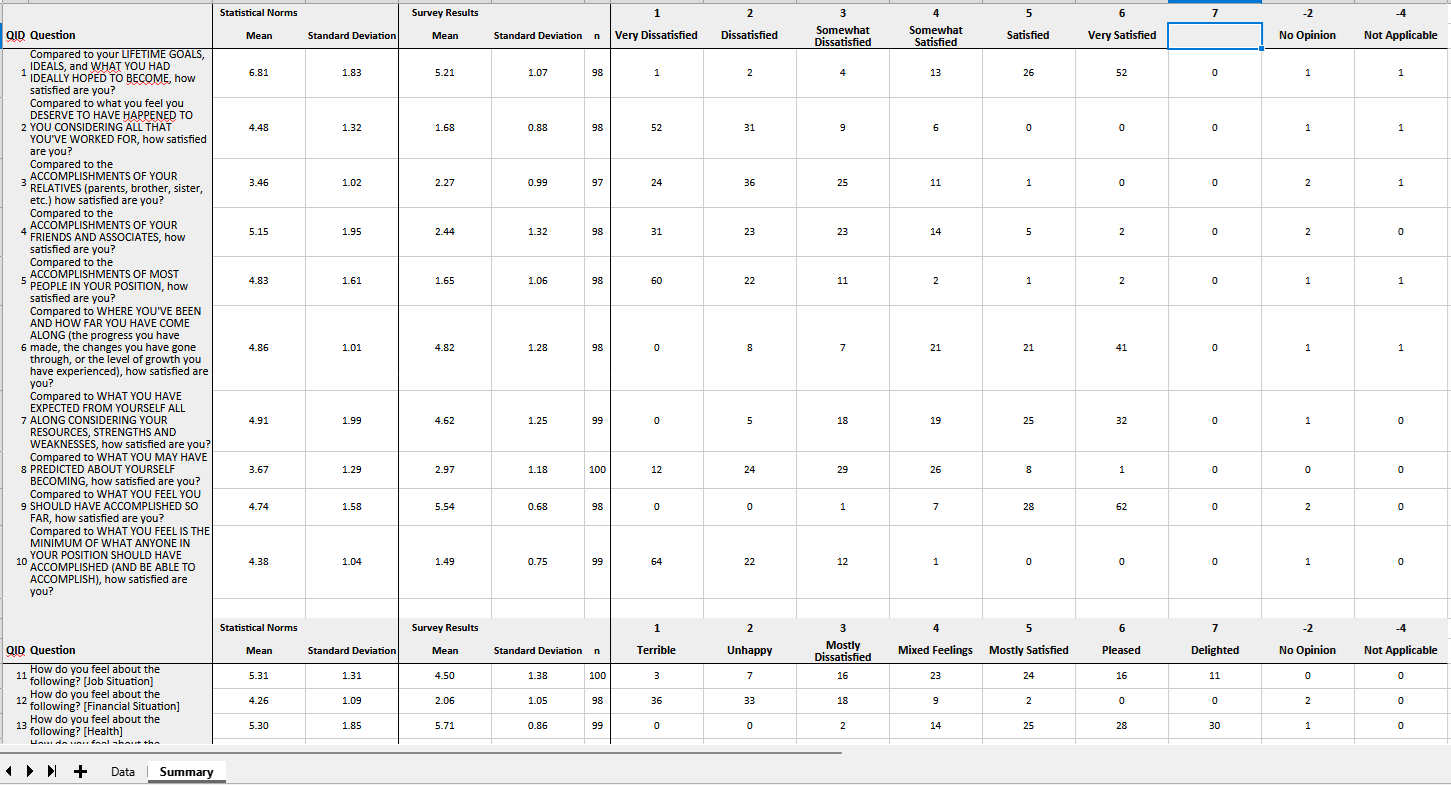
After the survey has been completed you will receive an Excel data file containing the survey data plus statistical norms for every survey item. A convenient summary sheet will be provided to quickly gauge the responses for each survey question, as well as the computed averages for important question sets.
- Data: The raw data containing the results from the survey.
- Summary: A sheet which summarizes the survey responses.
If the spreadsheet provided is insufficient for your needs, you may also want to consider asking MIQOLS to produce an official report. Official reports can provide not only an analysis and visualization (in the form of charts and graphs) for each survey item, but also further analysis with respect to specific demographics of interest.
The production of an official report varies greatly depending on the specific needs of clients. If you are interested in pursuing this option, please contact us (office@miqols.org) to discuss in detail your requirements.

The report is structured as follows:
- Cover page: A title page with applicant contact information and MIQOLS contact information
- Executive Summary: The entire content of the report is summarized here.
- Theory and Model: The theoretical model underlying the survey is described here and the theoretical constructs are clearly defined. The research supporting the model is also discussed in this section.
- Description of the Survey: This section contains a description of the constructs with corresponding survey items.
- Sampling and Data Collection: This part of the report describes the call issued to people to participate in the survey, the deadline imposed, any incentives used to encourage participation, the survey link, the number of people who actually participated in the survey, the total number of people contacted, and the response rate. The response rate is compared to past response rates.
- Survey Results: This section of the report provides descriptive statistics related to each survey item with figures (e.g., bar charts) against the norm. The norm is calculated based on the average of all past surveys that have been administered through MIQOLS.
- Discussion and Recommendations: The survey results are then summarized and interpreted in this section. As such, specific strengths and weaknesses are identified.
- References: Exact references of corresponding text citations are fleshed out in this section.
- Appendices: Extra detailed information related to any aspect of the report is placed in this section.
Example Reports
- Community-Quality-of-Life Example Report
- Consumer-Wellbeing Example Report
- Quality-of-College-Life Example Report
- Quality-of-Community-Healthcare Example Report
- Quality-of-Work-Life Example Report
Project Fee
$1000 to help set up the survey site for your data collection (guided by the validated survey measures). After the completion of data collection, we will deliver an Excel data file containing the survey data plus statistical norms for every survey item. If you would like a full report with charts and recommendations, you can contact our office to discuss in detail your requirements and the corresponding payment.
To request MIQOLS to conduct a Life Satisfaction Survey, please send an e-mail message to the executive director of MIQOLS, Joe Sirgy, at office@miqols.org indicating interest. You can also contact MIQOLS by letter (address: 6020 Lyons Road, Dublin, Virginia 24084, USA) or by phone (540-674-5022; leave voicemail message). A staff member will contact you by e-mail to set up a telephone (or Skype or ZOOM) meeting. The staff member will answer whatever questions you may have and discuss the logistics of the entire project, the cost, survey specifications, time line, delivery of the survey report and other details.
 miqols.org