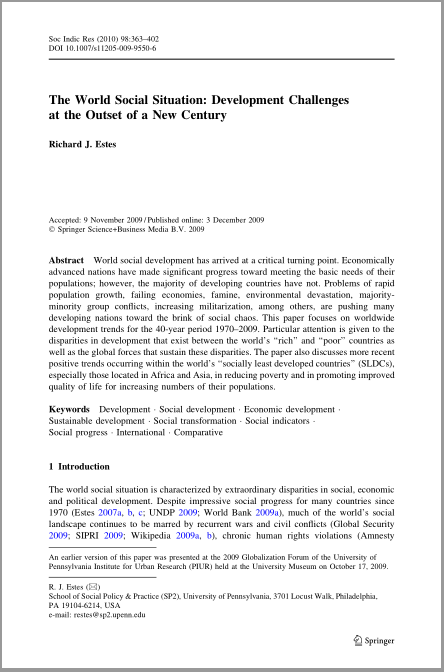
World social development has arrived at a critical turning point. Economically advanced nations have made significant progress toward meeting the basic needs of their populations; however, the majority of developing countries have not. Problems of rapid population growth, failing economies, famine, environmental devastation, majority-minority group conflicts, increasing militarization, among others, are pushing many developing nations toward the brink of social chaos. This paper focuses on worldwide development trends for the 40-year period 1970–2009. Particular attention is given to the disparities in development that exist between the world’s “rich” and “poor” countries as well as the global forces that sustain these disparities. The paper also discusses more recent positive trends occurring within the world’s “socially least developed countries” (SLDCs), especially those located in Africa and Asia, in reducing poverty and in promoting improved quality of life for increasing numbers of their populations.
Category : Supplemental Material
Development Trends in Islamic Societies: From Collective Wishes to Concerted Actions
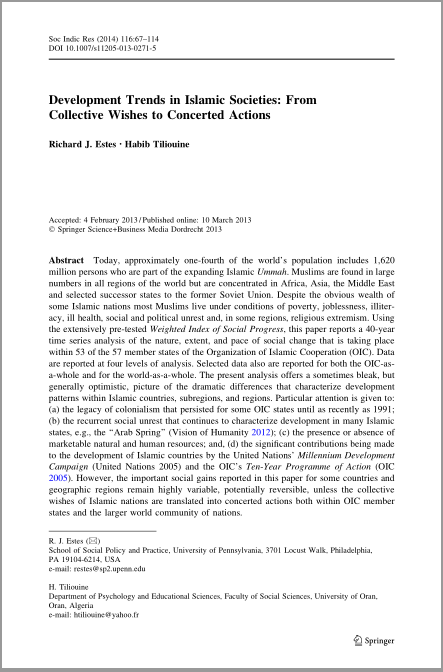
Today, approximately one-fourth of the world’s population includes 1,620 million persons who are part of the expanding Islamic Ummah. Muslims are found in large numbers in all regions of the world but are concentrated in Africa, Asia, the Middle East and selected successor states to the former Soviet Union. Despite the obvious wealth of some Islamic nations most Muslims live under conditions of poverty, joblessness, illiteracy, ill health, social and political unrest and, in some regions, religious extremism. Using the extensively pre-tested Weighted Index of Social Progress, this paper reports a 40-year time series analysis of the nature, extent, and pace of social change that is taking place within 53 of the 57 member states of the Organization of Islamic Cooperation (OIC). Data are reported at four levels of analysis. Selected data also are reported for both the OIC-as-a-whole and for the world-as-a-whole. The present analysis offers a sometimes bleak, but generally optimistic, picture of the dramatic differences that characterize development patterns within Islamic countries, subregions, and regions. Particular attention is given to: (a) the legacy of colonialism that persisted for some OIC states until as recently as 1991; (b) the recurrent social unrest that continues to characterize development in many Islamic states, e.g., the ‘‘Arab Spring’’ (Vision of Humanity 2012); (c) the presence or absence of marketable natural and human resources; and, (d) the significant contributions being made to the development of Islamic countries by the United Nations’ Millennium Development Campaign (United Nations 2005) and the OIC’s Ten-Year Programme of Action (OIC 2005). However, the important social gains reported in this paper for some countries and geographic regions remain highly variable, potentially reversible, unless the collective wishes of Islamic nations are translated into concerted actions both within OIC member states and the larger world community of nations.
Posted in Reports
Theory and Validity of Life Satisfaction Scales
National accounts of subjective well-being are being considered and adopted by nations. In order to be useful for policy deliberations, the measures of life satisfaction must be psychometrically sound. The reliability, validity, and sensitivity to change of life satisfaction measures are reviewed. The scales are stable under unchanging conditions, but are sensitive to changes in circumstances in people’s lives. Several types of data indicate that the scales validly reflect the quality of respondents’ lives: (1) Differences between nations in life satisfaction associated with differences in objective conditions, (2) Differences between groups who live in different circumstances, (3) Correlations with nonself-report measures of life satisfaction, (4) Genetic and physiological associations with life satisfaction, (5) Systematic patterns of change in the scales before, during, and after significant life events, and (6) Prediction by life satisfaction scores of future behaviors such as suicide. The life satisfaction scales can be influenced by factors such as question order, current mood, and mode of presentation, but in most cases these can be controlled. Our model of life satisfaction judgments points to the importance of attention, values, standards, and top-down effects. Although the scales are useful in research on individual well-
being, there are policy questions that need more analysis and research, such as which types of subjective well-being measures are most relevant to which types of policies, how standards influence scores, and how best to associate the scores with current policy deliberations.
Posted in Reports
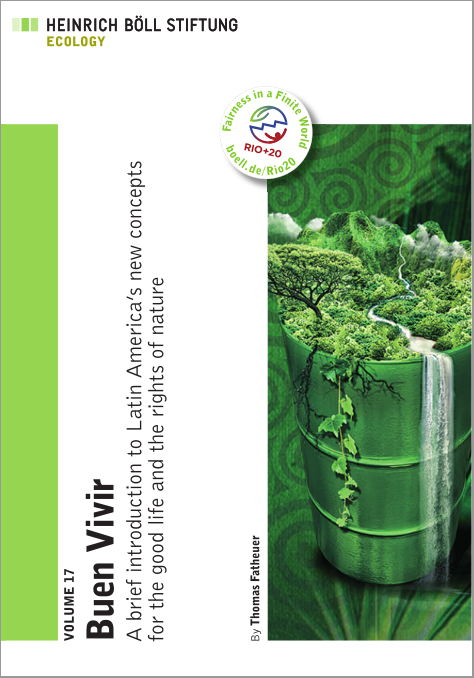
Buen Vivir
Posted in Reports
China’s life satisfaction, 1990–2010
Despite its unprecedented growth in output per capita in the last two decades, China has essentially followed the life satisfaction trajectory of the central and eastern European transition countries—a U-shaped swing and a nil or declining trend. There is no evidence of an increase in life satisfaction of the magnitude that might have been expected to result from the fourfold improvement in the level of per capita consumption that has occurred. As in the European countries, in China the trend and U-shaped pattern appear to be related to a pronounced rise in unemployment followed by a mild decline, and an accompanying dissolution of the social safety net along with growing income inequality. The burden of worsening life satisfaction in China has fallen chiefly on the lowest socioeconomic groups. An initially highly egalitarian distribution of life satisfaction has been replaced by an increasingly unequal one, with decreasing life satisfaction in persons in the bottom third of the income distribution and increasing life satisfaction in those in the top third.
Posted in Reports
Culture and Wellbeing: The Case of Indigenous Australians
A recurring theme in Indigenous affairs in Australia is a tension between maintenance of Indigenous culture and achievement of socio-economic ‘equity’: essentially ‘self-determination’ versus ‘assimilation’. Implicit in this tension is the view that attachment to traditional cultures and lifestyles is a hindrance to achieving ‘mainstream’ economic goals. Using data from the National Aboriginal and Torres Strait Islander Social Survey, stronger attachment to traditional culture is found to be associated with enhanced outcomes across a range of socio-economic indicators. This suggests Indigenous culture should be viewed a part of the solution to Indigenous disadvantage in Australia, and not as part of the problem.
Posted in Reports
Poverty, Vulnerability and Resilience in a Post-2015 World
Current statistical data suggest that there is mixed progress towards achieving the Millennium Development Goals (MDGs) by 2015. Some MDGs such as access to safe drinking water have already been reached at the global level (WHO/UNICEF 2012). However, such global success is largely due to overachievements by a few large developing countries such as China (UN 2012). In other countries progress is limited and this is especially so in Sub-Saharan Africa (Easterly 2009) and fragile and conflict affected states (UN 2012). Looking ahead, the global economic crisis (2007) may mark the end of a relatively benign era of strong growth, buoyant aid budgets and reasonable stability. Poverty reduction will then need to be pursued in a context of economic recovery, climate change, urbanization and demographic change.
Posted in Reports
Harmony in the World 2013: The Ideal and the Reality
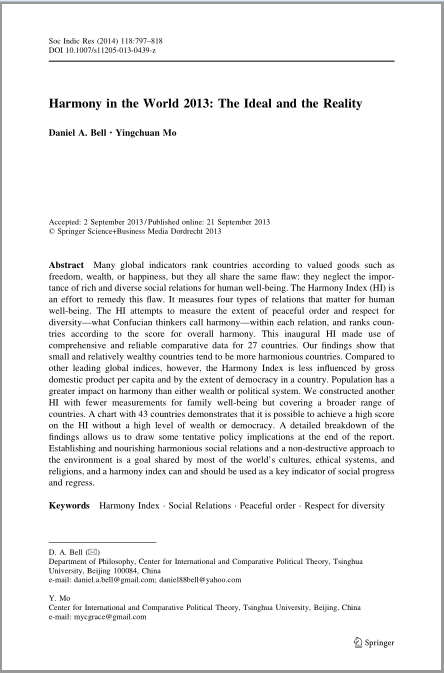
Many global indicators rank countries according to valued goods such as freedom, wealth, or happiness, but they all share the same flaw: they neglect the importance of rich and diverse social relations for human well-being. The Harmony Index (HI) is an effort to remedy this flaw. It measures four types of relations that matter for human well-being. The HI attempts to measure the extent of peaceful order and respect for diversity—what Confucian thinkers call harmony—within each relation, and ranks countries according to the score for overall harmony. This inaugural HI made use of comprehensive and reliable comparative data for 27 countries. Our findings show that small and relatively wealthy countries tend to be more harmonious countries. Compared to other leading global indices, however, the Harmony Index is less influenced by gross domestic product per capita and by the extent of democracy in a country. Population has a greater impact on harmony than either wealth or political system. We constructed another HI with fewer measurements for family well-being but covering a broader range of countries. A chart with 43 countries demonstrates that it is possible to achieve a high score on the HI without a high level of wealth or democracy. A detailed breakdown of the findings allows us to draw some tentative policy implications at the end of the report. Establishing and nourishing harmonious social relations and a non-destructive approach to the environment is a goal shared by most of the world’s cultures, ethical systems, and religions, and a harmony index can and should be used as a key indicator of social progress and regress.
Posted in Reports
Attitudes to Chronic Poverty in the ‘Global Village’
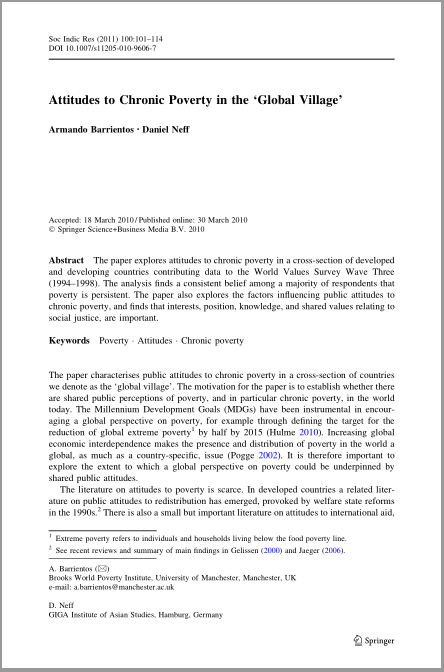
The paper explores attitudes to chronic poverty in a cross-section of developed and developing countries contributing data to the World Values Survey Wave Three (1994–1998). The analysis finds a consistent belief among a majority of respondents that poverty is persistent. The paper also explores the factors influencing public attitudes to chronic poverty, and finds that interests, position, knowledge, and shared values relating to social justice, are important.
Posted in Reports
Introduction to Ancient Western Philosophy
The history of ancient Western philosophy spans over a millennium, from its origins in the mid 7th century BCE approximately to the 6th century CE. This history mainly occurred in the region of modern day Greece, but also in Southern Italy, North Africa, and the Middle East. During the late Roman Republic and Empire, some important philosophical works were composed in Latin, but Greek prevailed as the language of philosophical and more generally intellectual activity throughout Western antiquity.
Posted in Reports