Consolidated Books Website

Category : Reports

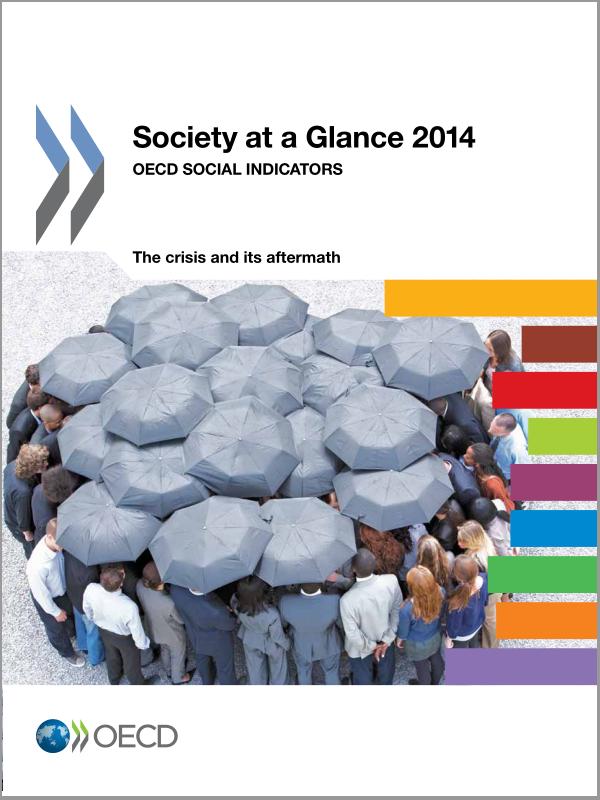
Society at a Glance 2014: OECD Social Indicators

This is the seventh edition of Society at a Glance, the OECD’s biennial overview of social indicators. As with its predecessors, this report addresses the growing demand for quantitative evidence on social well-being and its trends across OECD countries. It updates some indicators included in the previous six editions and introduces several new ones. Data for the other economies that are members of the G20 are included separately where available.

Before the onset of the financial and economic crisis in 2007-08, social spending across the OECD area accounted for about half of all government outlays. But while there are big demands on social protection systems during all phases of the economic cycle, the need for social support measures is especially acute during deep and extended economic downturns. Against this background, this edition of Society at a Glance takes stock of available information about the social challenges emerging since the beginning of the economic crisis, and countries’ policy responses to meet those challenges.
Posted in Reports

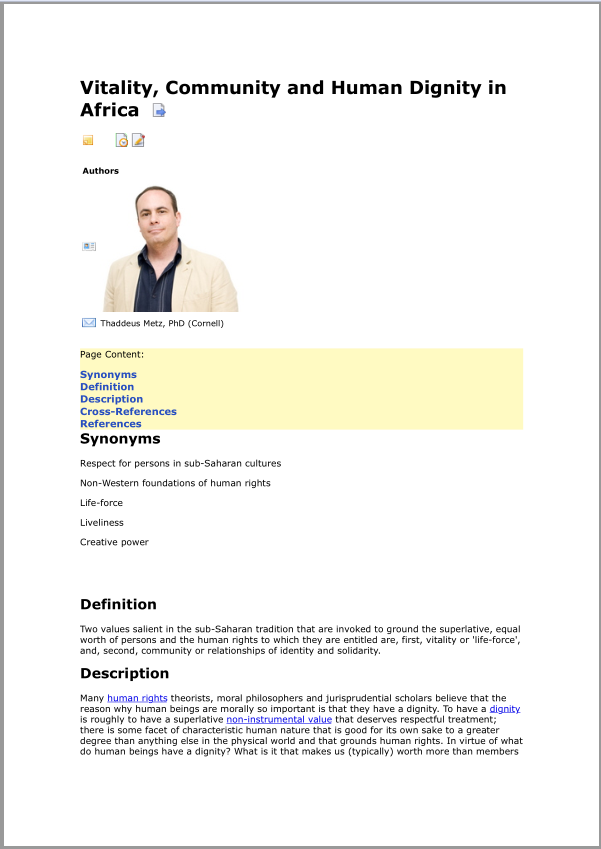
Vitality, Community and Human Dignity in Africa

Two values salient in the sub-Saharan tradition that are invoked to ground the superlative, equal worth of persons and the human rights to which they are entitled are, first, vitality or ‘life-force’, and, second, community or relationships of identity and solidarity.
Posted in Reports

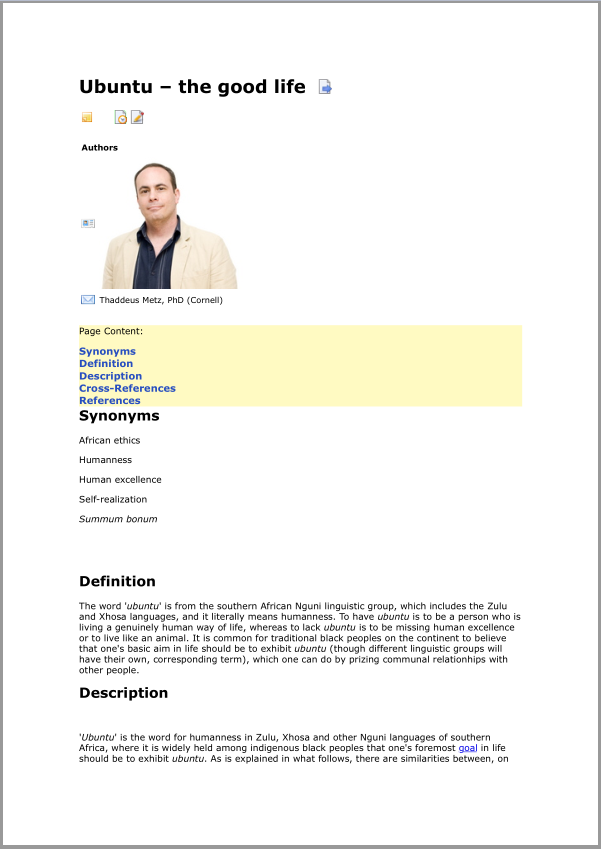
Ubuntu – the good life

The word ‘ubuntu’ is from the southern African Nguni linguistic group, which includes the Zulu and Xhosa languages, and it literally means humanness. To have ubuntu is to be a person who is living a genuinely human way of life, whereas to lack ubuntu is to be missing human excellence or to live like an animal. It is common for traditional black peoples on the continent to believe that one’s basic aim in life should be to exhibit ubuntu (though different linguistic groups will have their own, corresponding term), which one can do by prizing communal relationships with other people.
Posted in Reports

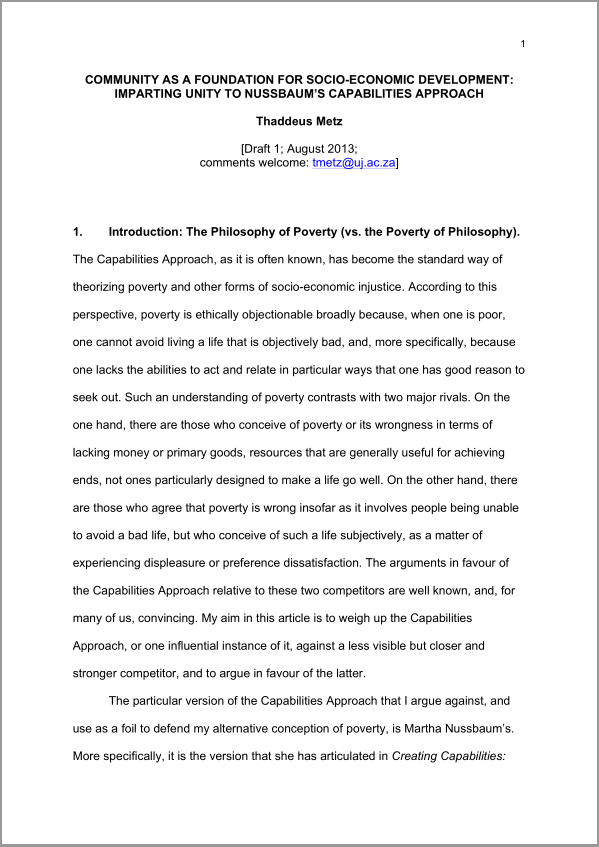
Community as a Foundation for Socio-Economic Development: Imparting Unity to Nussbaum’s Capabilities Approach

The Capabilities Approach, as it is often known, has become the standard way of theorizing poverty and other forms of socio-economic injustice. According to this perspective, poverty is ethically objectionable broadly because, when one is poor, one cannot avoid living a life that is objectively bad, and, more specifically, because one lacks the abilities to act and relate in particular ways that one has good reason to seek out. Such an understanding of poverty contrasts with two major rivals. On the one hand, there are those who conceive of poverty or its wrongness in terms of lacking money or primary goods, resources that are generally useful for achieving ends, not ones particularly designed to make a life go well. On the other hand, there are those who agree that poverty is wrong insofar as it involves people being unable to avoid a bad life, but who conceive of such a life subjectively, as a matter of experiencing displeasure or preference dissatisfaction.
Posted in Reports

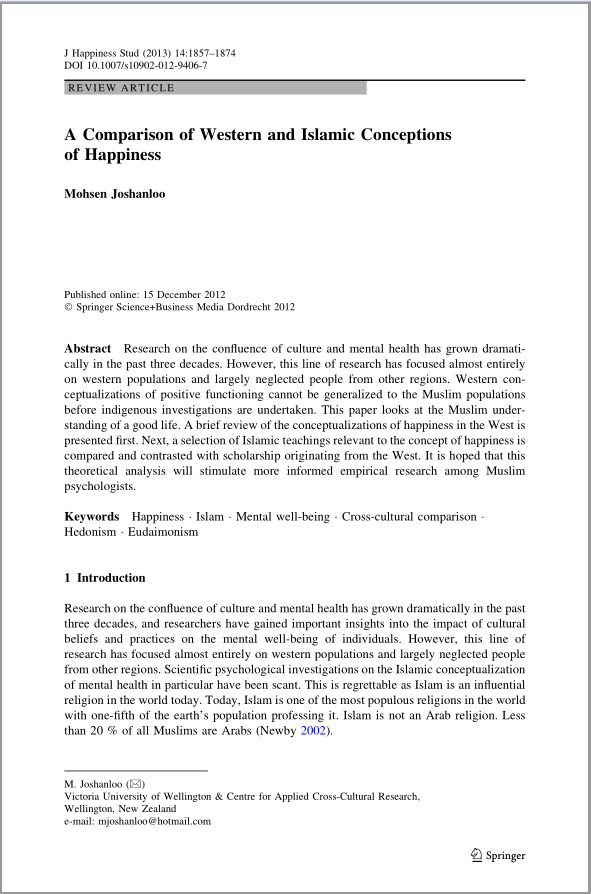
A Comparison of Western and Islamic Conceptions of Happiness

Research on the confluence of culture and mental health has grown dramatically in the past three decades. However, this line of research has focused almost entirely on western populations and largely neglected people from other regions. Western conceptualizations of positive functioning cannot be generalized to the Muslim populations before indigenous investigations are undertaken. This paper looks at the Muslim understanding of a good life. A brief review of the conceptualizations of happiness in the West is presented first. Next, a selection of Islamic teachings relevant to the concept of happiness is compared and contrasted with scholarship originating from the West. It is hoped that this theoretical analysis will stimulate more informed empirical research among Muslim psychologists.
Posted in Reports

Andean and Amazonian native conceptions of well-being

Amazonian and Andean native conceptions of well-being is referred to as different well-being patterns found in traditional communities in the Cordillera of the Andes and the Amazonian rainforest. The adaptation to modernity of these cultures and its impact in well-being is also discussed.
Posted in Reports

Human Development Report 2013

The 2013 Human Development Report is the latest in the series of global Human Development Reports published by UNDP since 1990 as independent, empirically grounded analyses of major development issues, trends and policies.

Additional resources related to the 2013 Human Development Report can be found online at http://hdr.undp.org, including complete editions or summaries of the Report in more than 20 languages, a collection of Human Development Research Papers commissioned for the 2013 Report, interactive maps and databases of national human development indicators, full explanations of the sources and methodologies employed in the Report’s human development indices, country profiles and other background materials as well as previous global, regional and national Human Development Reports.

Posted in Reports

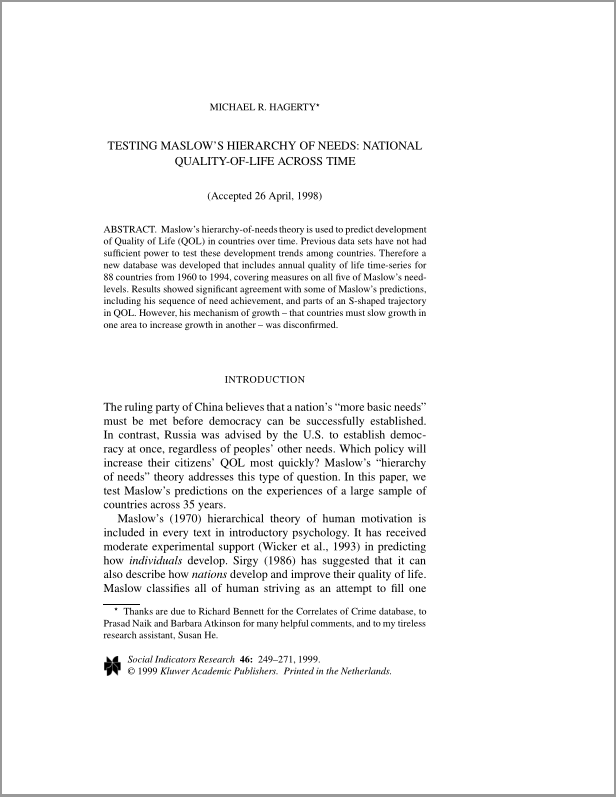
Testing Maslow’s Hierarchy of Needs: National Quality-of-Life Across Time

Maslow’s hierarchy-of-needstheoryis used to predict development of Quality of Life (QOL) in countries over time. Previous data sets have not had sufficient power to test these development trends among countries. Therefore a new database was developed that includes annual quality of life time-series for 88 countries from 1960 to 1994, covering measures on all five of Maslow’s need-levels. Results showed significant agreement with some of Maslow’s predictions, including his sequence of need achievement, and parts of an S-shaped trajectory in QOL. However, his mechanism of growth – that countries must slow growth in one area to increase growth in another – was disconfirmed.
Posted in Reports

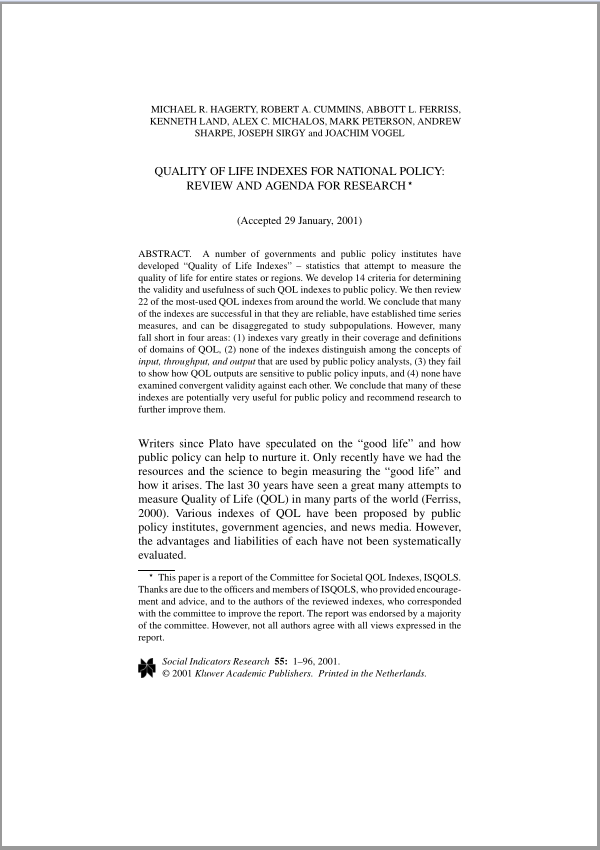
Quality of Life Indexes for National Policy: Review and Agenda for Research

A number of governments and public policy institutes have developed “Quality of Life Indexes” – statistics that attempt to measure the quality of life for entire states or regions. We develop 14 criteria for determining the validity and usefulness of such QOL indexes to public policy. We then review 22 of the most-used QOL indexes from around the world. We conclude that many of the indexes are successful in that they are reliable, have established time series measures, and can be disaggregated to study subpopulations. However, many fall short in four areas: (1) indexes vary greatly in their coverage and definitions of domains of QOL, (2) none of the indexes distinguish among the concepts of input, throughput, and output that are used by public policy analysts, (3) they fail to show how QOL outputs are sensitive to public policy inputs, and (4) none have examined convergent validity against each other. We conclude that many of these indexes are potentially very useful for public policy and recommend research to further improve them.
Posted in Reports

OECD Guidelines on Measuring Subjective Well-being

These guidelines provide advice on the collection and use of measures of subjective well-being. They are intended to provide support for national statistical offices and other producers of subjective well-being data in designing, collecting, and publishing measures of subjective well-being. In addition, the guidelines are designed to be of value to users of information on subjective well-being.

The guidelines provide information on the validity of subjective well-being measures; discuss the main methodological issues in developing questions to collect information on subjective well-being; present best practice in the measurement of subjective well-being; and provide guidance on the analysis and reporting of subjective well-being measures. A number of prototype question modules relating to different aspects of subjective well-being are also included.

These guidelines should be viewed as providing advice on best practice rather than being a formal statistical standard. At present, countries differ in terms of how much interest they have in information on subjective well-being, and in terms of the ability of national statistical offices to collect such data. The role of the guidelines, therefore, is primarily to assist data producers in meeting the needs of users by bringing together what is currently known on how to produce high quality, comparable measures of subjective well-being. As an international governmental organisation, the OECD has a particular interest in encouraging international comparability of data, and this is one of the key objectives of this report.

Posted in Reports