Consolidated Books Website

Category : Supplemental Material

The Measurement of Progress and Well-Being

The Law of Science and Technology, published in June, 2002, proposed some important modifications to the legislation on this matter, such as: the creation of the General Council of Scientific Research and Technological Development, the identification of the National Council of Science and Technology (CONACYT) as head of the science and technology sector, and the creation of the Scientific and Technological Consultative Forum (FCCyT).
Posted in Reports

Positive Peace Report 2015

Humanity is now facing challenges unparalleled in its history. The most urgent challenges are global in nature, such as climate change, ever decreasing biodiversity, increasing migration and over-population. These global challenges call for global solutions and these solutions require cooperation on a scale unprecedented in human history. In a globalised world, the sources of many of these challenges are multidimensional, increasingly complex and span national borders. For this reason, finding solutions to these unprecedented challenges fundamentally requires new thinking.
Posted in Reports

How’s Life? Measuring Well-Being

This report is published under the responsibility of the Secretary General of the OECD. The opinions expressed and arguments employed herein do not necessarily reflect the official views of the Organisation or of the governments of its member countries.

The report was prepared by the Well-Being Unit of the OECD Directorate of Statistics: Carlotta Balestra (chapters 10 and 11), Romina Boarini (chapters 1 and 7), Michael de Looper and Gaetan Lafortune (chapter 5), Fabiola Riccardini (chapter 3), Nicolas Ruiz (chapter 2), Katherine Scrivens (chapters 6 and 8), Conal Smith (chapter 12), Joyce Sultan (chapters 4 and 9), under the supervision of Romina Boarini, Marco Mira d’Ercole and Martine Durand. Statistical assistance was provided by Elena Tosetto. Editorial assistance was provided by Germán Morales, Susannah Nash, Ingrid Herrbach and Sonia Primot. The report has benefited from contributions and comments from staff of other OECD Directorates and from national delegates to the OECD Committee on Statistics.

Posted in Reports

How Was Life? Global Well-Being since 1820

I n 2001, the OECD Development Centre released Angus Maddison’s book, The World economy – a Millennial Perspective, which was soon to become a classic in economic history for statisticians, economists and historians. Angus had a very long association with the Organisation for Economic Cooperation and Development (OECD), which he joined in 1953, and was one of the founding fathers of its Development Centre. This enthusiastic and thought-provoking “chiffrephile” – as he used to call himself – devoted much of his career to quantifying and analysing long-term growth in output as well as achievements in development and social welfare over the past millennium in as many countries of the world as possible. In doing this, he greatly contributed to one of the core missions of the OECD: providing the evidence for policy-making.
Posted in Reports

OECD Factbook 2014

The OECD Factbook is the most comprehensive OECD publication on statistics. The Factbook contains a wide set of internationally comparable indicators that allows users to assess and compare countries’ performance over time in a wide range of areas that are at the heart of citizens’ and policy-makers’ concerns.

Written in a non-technical language, the OECD Factbook provides more than 100 indicators for all 34 OECD member countries and, when available and considered internationally comparable, for Brazil, India, Indonesia, the People’s Republic of China, the Russian Federation and South Africa.

Data presented in the OECD Factbook are also available online through OECD.StatExtracts, the OECD platform for data dissemination, and as of June 2014 the new OECD data portal. The OECD Factbook, in its various formats, thus represents a first-stop, easy tool for all those who are looking for reliable, trustworthy and internationally comparable statistics.

Posted in Reports

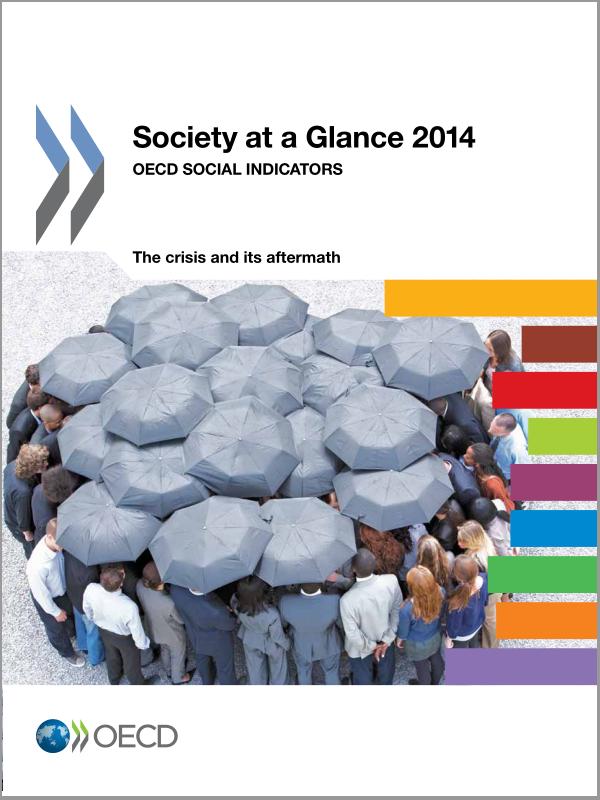
Society at a Glance 2014: OECD Social Indicators

This is the seventh edition of Society at a Glance, the OECD’s biennial overview of social indicators. As with its predecessors, this report addresses the growing demand for quantitative evidence on social well-being and its trends across OECD countries. It updates some indicators included in the previous six editions and introduces several new ones. Data for the other economies that are members of the G20 are included separately where available.

Before the onset of the financial and economic crisis in 2007-08, social spending across the OECD area accounted for about half of all government outlays. But while there are big demands on social protection systems during all phases of the economic cycle, the need for social support measures is especially acute during deep and extended economic downturns. Against this background, this edition of Society at a Glance takes stock of available information about the social challenges emerging since the beginning of the economic crisis, and countries’ policy responses to meet those challenges.

Posted in Reports

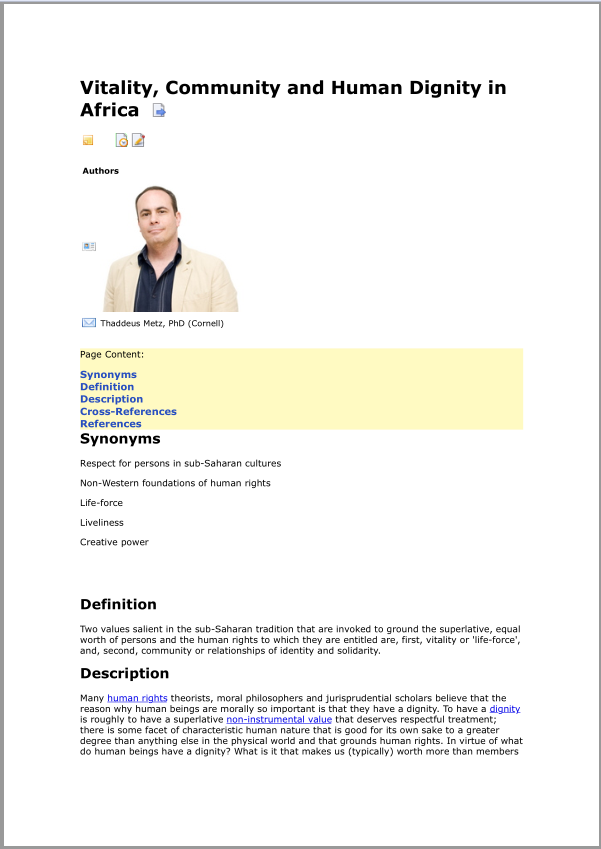
Vitality, Community and Human Dignity in Africa

Two values salient in the sub-Saharan tradition that are invoked to ground the superlative, equal worth of persons and the human rights to which they are entitled are, first, vitality or ‘life-force’, and, second, community or relationships of identity and solidarity.
Posted in Reports

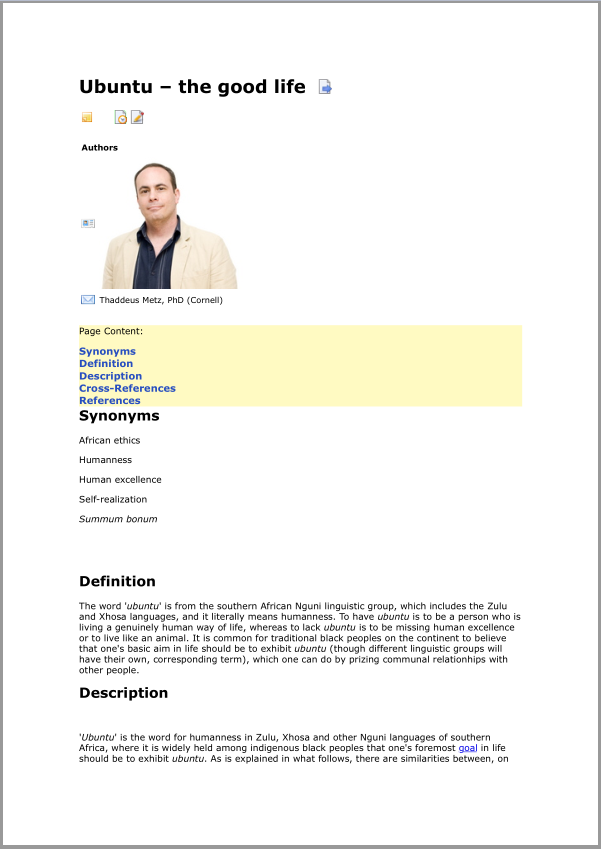
Ubuntu – the good life

The word ‘ubuntu’ is from the southern African Nguni linguistic group, which includes the Zulu and Xhosa languages, and it literally means humanness. To have ubuntu is to be a person who is living a genuinely human way of life, whereas to lack ubuntu is to be missing human excellence or to live like an animal. It is common for traditional black peoples on the continent to believe that one’s basic aim in life should be to exhibit ubuntu (though different linguistic groups will have their own, corresponding term), which one can do by prizing communal relationships with other people.
Posted in Reports

Community as a Foundation for Socio-Economic Development: Imparting Unity to Nussbaum’s Capabilities Approach

The Capabilities Approach, as it is often known, has become the standard way of theorizing poverty and other forms of socio-economic injustice. According to this perspective, poverty is ethically objectionable broadly because, when one is poor, one cannot avoid living a life that is objectively bad, and, more specifically, because one lacks the abilities to act and relate in particular ways that one has good reason to seek out. Such an understanding of poverty contrasts with two major rivals. On the one hand, there are those who conceive of poverty or its wrongness in terms of lacking money or primary goods, resources that are generally useful for achieving ends, not ones particularly designed to make a life go well. On the other hand, there are those who agree that poverty is wrong insofar as it involves people being unable to avoid a bad life, but who conceive of such a life subjectively, as a matter of experiencing displeasure or preference dissatisfaction.
Posted in Reports

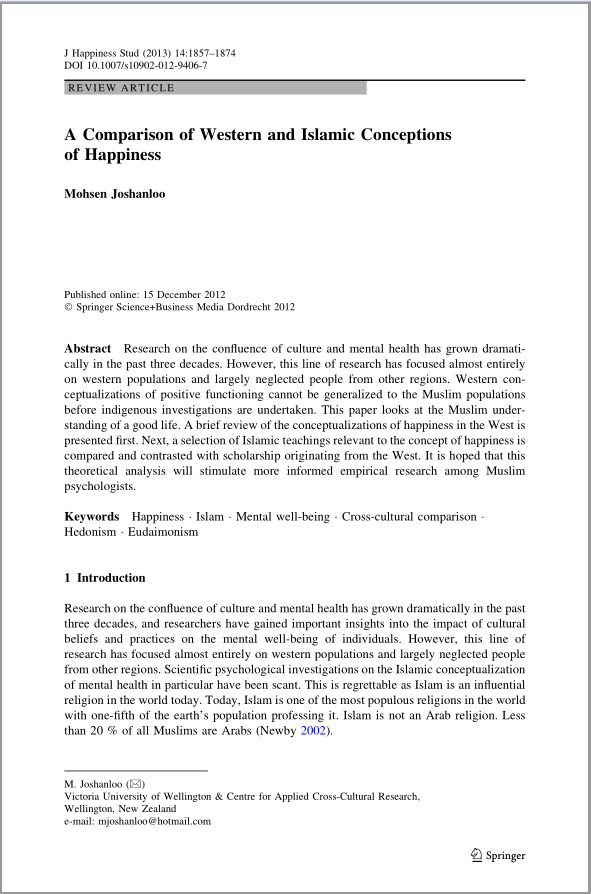
A Comparison of Western and Islamic Conceptions of Happiness

Research on the confluence of culture and mental health has grown dramatically in the past three decades. However, this line of research has focused almost entirely on western populations and largely neglected people from other regions. Western conceptualizations of positive functioning cannot be generalized to the Muslim populations before indigenous investigations are undertaken. This paper looks at the Muslim understanding of a good life. A brief review of the conceptualizations of happiness in the West is presented first. Next, a selection of Islamic teachings relevant to the concept of happiness is compared and contrasted with scholarship originating from the West. It is hoped that this theoretical analysis will stimulate more informed empirical research among Muslim psychologists.
Posted in Reports