

There are two community life surveys:
Community-Quality-of-Life Survey
The Community-Quality-of-Life Survey is a standardized survey that has been administered in many communities in the U.S. and other countries to assess the level of community well-being.
To Learn More, Click HereHost Community Residents’ Satisfaction with Tourism Development
The Host Community Residents’ Satisfaction with Tourism Development Survey links community residents’ perceptions of tourism impact (economic, social, cultural, and environmental) with residents’ satisfaction with particular life domains (material well-being, community well-being, emotional well-being, and health and safety well-being) and overall life satisfaction.
To Learn More, Click HereCommunity-Quality-of-Life Survey
The Community-Quality-of-Life Survey is a standardized survey that has been administered in many communities in the U.S. and other countries to assess the level of community well-being.
Host Community Residents’ Satisfaction with Tourism Development
The Host Community Residents’ Satisfaction with Tourism Development Survey links community residents’ perceptions of tourism impact (economic, social, cultural, and environmental) with residents’ satisfaction with particular life domains (material well-being, community well-being, emotional well-being, and health and safety well-being) and overall life satisfaction.

The Theoretical Model
The Community-Quality-of-Life measure is essentially based on bottom-up theory of life satisfaction, a theory widely accepted in quality-of-life studies (e.g., Andrews and Withey, 1976; Campbell, Converse, & Rodgers, 1976). The basic premise of bottom-up theory is that life satisfaction of community residents is influenced by satisfaction they experience about their life domains and sub-domains. Specifically, life satisfaction is construed to be on top of a satisfaction hierarchy and is mostly determined by satisfaction with life domains (e.g., satisfaction with community, family, work, social life, health, and so on). Satisfaction with a particular life domain (e.g., satisfaction with community life), in turn, is influenced by lower levels of life concerns within that domain (e.g., satisfaction with services provided in the local community). Hence, residents who feel highly satisfied with their various life domains (i.e., high satisfaction with community life, health life, work life, family life, neighborhood life, and leisure life) are likely to express high levels of life satisfaction in general. The affect within those life domains spills over vertically to the most super-ordinate domain (life in general), thus determining life satisfaction. Similarly, satisfaction with community life is mostly determined by satisfaction with the life conditions/concerns associated with community life domain such as services and conditions in the community.
The Theoretical Model
The model reflects three major propositions: (1) residents’ perception of tourism impact affects their sense of well-being in various life domains (material, community, emotional, and health/ safety well-being), (2) residents’ sense of well-being in those life domains affects their life satisfaction in general, and (3) the relationship between residents’ perception of tourism impact and their sense of well-being in those life domains is moderated by tourism development stages.
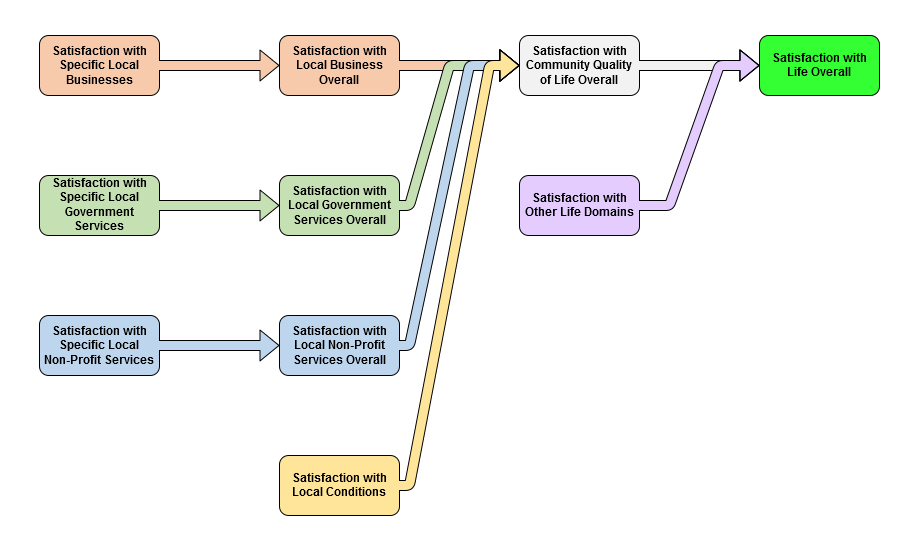

Community-Quality-of-Life Survey
A standard community-quality-of-life survey is separated into seven major sections.
I. LOCAL CONDITIONS
physical environment, neighborhood, housing, public safety, cost of utilities, real estate taxes
II. SPECIFIC BUSINESS
banking, insurance, restaurants and night clubs, department stores, drug stores and supermarkets, healthcare, telephone, electricity, gas and oil, etc.
III. SPECIFIC GOVERNMENT
fire department, rescue squad, library, sanitation services, water services, postal service, police, town or city administration, economic development, etc.
IV. SPECIFIC NONPROFITS
adoption services, family planning services, religious services, senior services, food and shelter nonprofits, volunteers, youth services, etc.
V. OTHER LIFE DOMAINS
work, finance, health, education, social life, leisure, spiritual life, culture, social status
VI. OVERALL SATISFACTION
life in general, community in general, local business overall, local government overall, local nonprofits overall
VII. DEMOGRAPHICS
age, gender, marital status, full-time vs. part-time employment, etc.
Host Community Residents’ Satisfaction with Tourism Development Survey
A standard Host Community Residents’ Satisfaction with Tourism Development Survey is separated into several major sections.
I. ECONOMIC IMPACT
employment opportunities, revenue from tourism, standard of living
II. SOCIAL IMPACT
variety of entertainment, maintenance of infrastructure and local services, recreational opportunities
III. CULTURAL IMPACT
meeting tourists from other places, cultural exchange
IV. ENVIRONMENTAL IMPACT
waste production, littering
V. MATERIAL WELLBEING
income and employment, cost of living
VI. COMMUNITY WELLBEING
facilities, citizens of community
VII. EMOTIONAL WELLBEING
spare time, leisure life, cultural life
VIII. HEALTH AND SAFETY
health and safety
IX. OTHER LIFE DOMAINS
work, finance, health, education, social life, leisure, spiritual life, culture, social status
X. OVERALL SATISFACTION
life in general
XI. DEMOGRAPHICS
age, gender, marital status, full-time vs. part-time employment, etc.
Community-Quality-of-Life Report
All reports share a common structure.
COVER PAGE
A title page with applicant contact information and MIQOLS contact information.
EXECUTIVE SUMMARY
The entire content of the report is summarized here.
THEORY AND MODEL
The theoretical model underlying the survey is described here and the theoretical constructs are clearly defined. The research supporting the model is also discussed in this section.
DESCRIPTION OF THE SURVEY
This section contains a description of the constructs with corresponding survey items.
SAMPLING AND DATA COLLECTION
This part of the report describes the call issued to people to participate in the Community-Quality-of-Life Survey, the deadline imposed, any incentives used to encourage participation, the survey link, the number of people who actually participated in the survey, the total number of people contacted, and the response rate. The response rate of each question is compared to past response rates of other communities.
SURVEY RESULTS
This section of the report provides descriptive statistics related to each survey item with figures (e.g., bar charts) against the norm. The norm is calculated based on the average of all past surveys that have been administered through MIQOLS.
DISCUSSION AND RECOMMENDATIONS
The survey results are then summarized and interpreted in this section. As such, specific strengths and weaknesses are identified.
REFERENCES
Exact references of corresponding text citations are fleshed out in this section.
APPENDICES
Extra detailed information related to any aspect of the report is placed in this section.
Host Community Residents’ Satisfaction with Tourism Development Report
All reports share a common structure.
COVER PAGE
A title page with applicant contact information and MIQOLS contact information.
EXECUTIVE SUMMARY
The entire content of the report is summarized here.
THEORY AND MODEL
The theoretical model underlying the survey is described here and the theoretical constructs are clearly defined. The research supporting the model is also discussed in this section.
DESCRIPTION OF THE SURVEY
This section contains a description of the constructs with corresponding survey items.
SAMPLING AND DATA COLLECTION
This part of the report describes the call issued to people to participate in the Community-Quality-of-Life Survey, the deadline imposed, any incentives used to encourage participation, the survey link, the number of people who actually participated in the survey, the total number of people contacted, and the response rate. The response rate of each question is compared to past response rates of other communities.
SURVEY RESULTS
This section of the report provides descriptive statistics related to each survey item with figures (e.g., bar charts) against the norm. The norm is calculated based on the average of all past surveys that have been administered through MIQOLS.
DISCUSSION AND RECOMMENDATIONS
The survey results are then summarized and interpreted in this section. As such, specific strengths and weaknesses are identified.
REFERENCES
Exact references of corresponding text citations are fleshed out in this section.
APPENDICES
Extra detailed information related to any aspect of the report is placed in this section.
 miqols.org